Abstract
Training in reservoir computing (RC) requires using an initial part of the input sequence for the reservoir internal state to synchronize with the driver. The length of this transient, often treated as an empirical washout parameter, is a critical resource: too short and training fails, too long and data are wasted. These synchronization transients are quantified and explain when and why they become prohibitively long. For spectral radius ρ<1 (the largest absolute eigenvalue of the recurrent weight matrix), a closed-form upper bound is derived from the linearized dynamics that captures the dependence on tolerance and typical initial separation. Near and above unity, ensemble experiments reveal heavy-tailed transient-time distributions: most realizations synchronize quickly, yet a non-negligible fraction requires orders of magnitude longer washout. Non-linear saturation under driving shortens transients and can restore the Echo State Property even for ρ>1, with rates controlled by input amplitude and leakage. At zero input, persistence vs silence is dictated by topology: interpreting the recurrent weight matrix A as a directed graph and decomposing it into cycles explains which nodes sustain activity (core), which inherit it downstream (driven), and which die out (quiescent). This structure-dynamics correspondence yields practical design rules: pre-screen reservoirs by monitoring state distances; favor cycle-rich topologies or nodes downstream of cycles; avoid very sparse or very dense regimes at large ρ; and tune input scaling/leakage to exploit saturation. Overall, this turns “washout” from a heuristic into a measurable, engineerable property with clear levers for robust, data-efficient RC.
More research
2025
Emergent Behavior and Computational Capabilities in Nonlinear Systems: Advancing Applications in Time Series Forecasting and Predictive Modeling
Kárel García-Medina, Daniel Estevez-Moya, Ernesto Estevez-Rams, Reinhard B. Neder
ITISE 2025, 17
2022
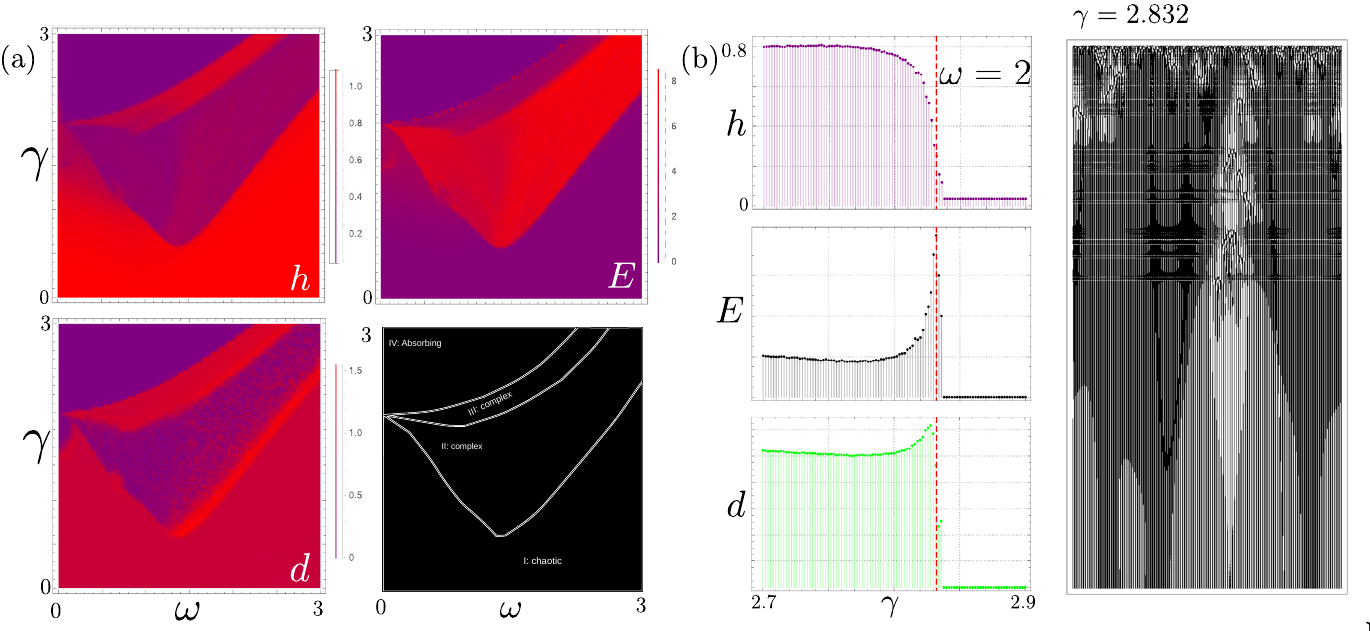
Damage spreading and information distance in cellular automata
Karel Garcia-Medina, Daniel Estevez-Moya, Ernesto Estevez-Rams
Revista Cubana de Física, 39, 90
2019
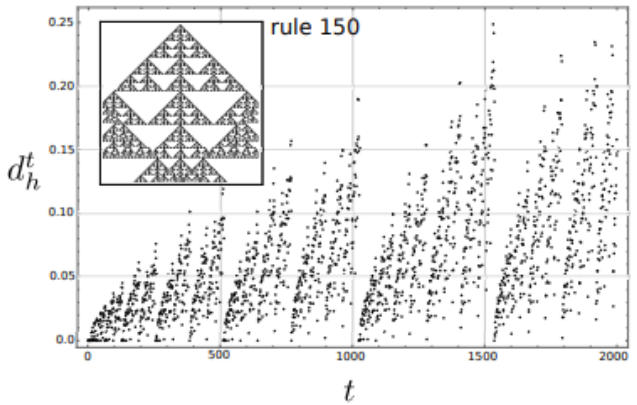
Complexity-entropy analysis at different levels of organisation in written language
Ernesto Estevez-Rams, Ania Mesa-Rodriguez, Daniel Estevez-Moya
PLOS ONE, 14(5), e0214863